Why Do Cats Knead? 5 Reasons and 1 Warning Sign
The leading explanation is that kneading is a leftover from nursing. But a sudden jump in how often your cat does it can mean something else.
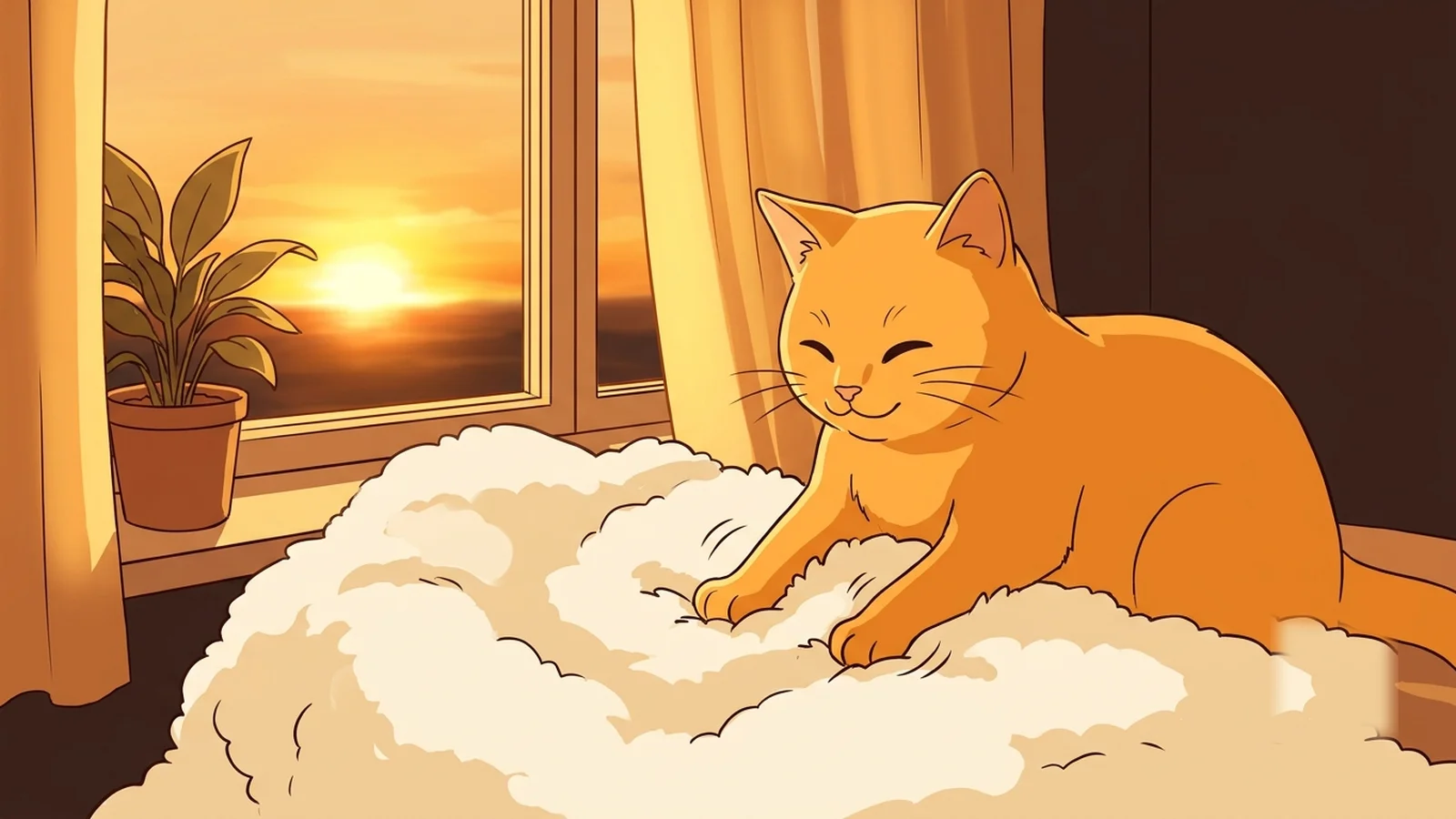
Cats knead, or "make biscuits," mostly because of a habit they picked up while nursing: kittens press on their mother's belly to get milk flowing, and many cats keep the motion into adulthood. Comfort, affection, scent marking and preparing a resting spot are the other explanations you will hear. None of them is fully proven. Susan Nelson, a veterinarian at Kansas State University, told Scientific American (September 7, 2023) that some of these are theories because nobody knows for sure. What follows sticks to what veterinary researchers and an animal hospital network have actually said.
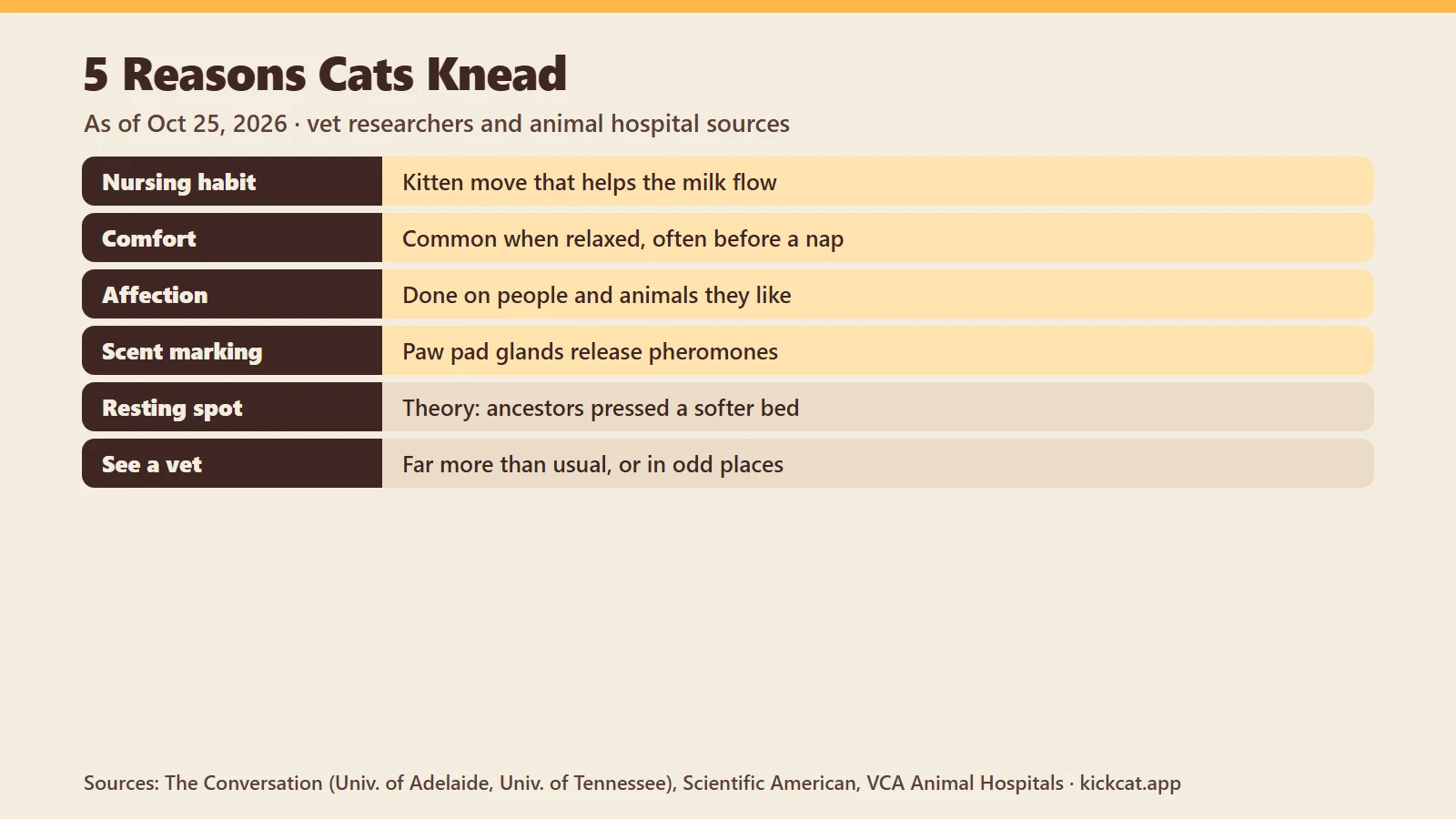
5 reasons cats knead
| Reason | What it means | Source |
|---|---|---|
| 1. Nursing habit | Kittens press on the mother's belly to help milk flow | University of Adelaide researchers, VCA Animal Hospitals |
| 2. Comfort | Common in relaxed cats, often right before a nap | University of Tennessee, VCA Animal Hospitals |
| 3. Affection | Done on people and animals the cat likes | VCA Animal Hospitals, University of Adelaide researchers |
| 4. Scent marking | Glands in the paw pads release pheromones | University of Adelaide researchers, Oklahoma State University |
| 5. Resting spot | A theory that wild ancestors pressed down a softer place to rest | VCA Animal Hospitals |
1. It starts with nursing
Susan Hazel and Julia Henning of the University of Adelaide's School of Animal and Veterinary Science explained it in The Conversation (December 8, 2022). When a kitten kneads while nursing, it helps trigger the release of oxytocin in the mother, which keeps the milk coming. That, they write, is likely why the behavior evolved in the first place.
Keeping juvenile traits into adulthood is called neoteny. Hazel and Henning suggest kneading stuck around in adult cats because it is useful for communicating with people and other animals.
2. It shows up when a cat is relaxed
Julia Albright, an associate professor of veterinary medicine at the University of Tennessee, describes kneading as a sign of a relaxed cat (The Conversation, June 14, 2021). Adult cats often do it right before a nap. VCA Animal Hospitals takes the same view: a cat that is kneading is usually comfortable.
Nelson adds that some cats drool while they knead, and she links that to especially happy cats.
3. It is aimed at someone they like
According to VCA Animal Hospitals, cats don't usually knead on people or animals they don't like. The Adelaide researchers read lap kneading as affiliative behavior, a sign the cat counts you as part of its social group.
They also point out that owners can reinforce the habit by giving attention every time it happens. If your cat seems to knead only you, both of those may be at work.
4. It leaves a scent
Cats have scent glands in their paws. The Adelaide researchers write that these glands release pheromones during kneading. Leticia Fanucchi, an animal behavior scientist at Oklahoma State University, told Scientific American this can mark a person or a sleeping spot as the cat's own. She also notes that kneading stretches the muscles.
Albright adds a caution: the glands between the toes are not easy to see.
5. It prepares a place to rest
VCA Animal Hospitals suggests that outdoor ancestors may have kneaded to create a softer place to rest. Even VCA frames this as a "may have," so treat it as a hypothesis. It does fit the cat that pads at a blanket for a while before finally lying down.
The warning sign: when kneading changes
Kneading itself is normal. The one thing to watch is change.
- Much more kneading than usual: VCA Animal Hospitals says kneading far more than normal, or in unusual places such as under the bed, may signal a problem.
- Other changes alongside it: VCA suggests checking for things like more hiding or a change in appetite.
- Compulsive kneading and sucking: the Adelaide researchers say kneading and sucking that is very frequent, long-lasting, or damaging to the paws, legs or mouth may point to stress or pain, and the cat should see a vet. It is a particular problem in Siamese and Birman cats.
- Kneading while unwell: cats who don't feel well sometimes purr and knead to soothe themselves, according to VCA and Kristyn Vitale, a certified applied animal behaviorist at Unity Environmental University. Kneading does not always mean a happy cat.
On the other side, some cats never knead at all, and the Adelaide researchers say that is normal.
This article is not veterinary advice. If you notice a change that worries you, talk to your vet.
4 ways to handle painful claws
- Put down a thick blanket. Cover your legs before the cat settles in (University of Adelaide researchers).
- Don't scold or push the cat off. The same researchers advise against both.
- Reward kneading with the claws in. Pet the cat or give a treat when it kneads with retracted claws. They also suggest pairing a cue word, such as "pads!", with the reward.
- Trim the claws and give it a spot. VCA recommends keeping claws trimmed short and steering kneading to a designated area with treats, toys and pheromone sprays.
So what should you do?
- If the kneading hurts: start with a thick blanket. Scolding a cat for treating you like family sends the wrong message.
- If it suddenly increased: look for other changes, such as appetite or hiding, and call your vet.
- If your cat never kneads: that can be normal. Albright says the cat may simply show affection another way.
For more on why cats behave the way they do, see 3 Real Reasons Cats Sleep 12 to 16 Hours a Day and 5 Real Reasons Big Dogs Back Down From Tiny Cats. The cat in our own game kicks instead of kneads: KickCat is a free-to-start idle game, and the cat keeps kicking the ball even after you close the app.
This guide reflects sources checked as of October 25, 2026: The Conversation (articles by University of Adelaide and University of Tennessee researchers), Scientific American and VCA Animal Hospitals.
FAQ
Why do cats knead?
The most widely accepted explanation is that kneading is left over from nursing, when kittens press on their mother's belly to get milk flowing. In adult cats, researchers also link it to comfort, affection and scent marking through glands in the paw pads.
Does my cat kneading me mean it likes me?
Usually, yes. VCA Animal Hospitals says cats don't usually knead on people or animals they don't like. Some cats also knead to soothe themselves when they feel unwell, so look at the whole picture.
Is it normal if my cat never kneads?
Yes, some cats never knead, and University of Adelaide researchers describe that as normal. Julia Albright of the University of Tennessee notes such a cat may show affection in other ways, though it could also be a little stressed.
How do I stop kneading claws from hurting?
Don't scold the cat or push it away; put a thick blanket over your lap instead. Reward kneading done with the claws retracted, and keep the claws trimmed short.