5 Real Reasons Cats Purr, and Not All of Them Are Happy
A purr isn't a happiness meter. Cats use the same sound to beg for food, to calm themselves at the vet, and while they're hurt.

Most people read a purr as a sign of a happy cat. That's only half right. Cats also purr when they want breakfast, when they're frightened on a vet's exam table, and when they're injured. Below is how the sound is made and why cats make it, based on veterinary and research sources.
How does a cat actually purr?
Leslie A. Lyons of the UC Davis School of Veterinary Medicine, answering a reader question for Scientific American, described the purr as a sound of about 25 to 150 Hz. Cats purr in the same steady pattern while breathing in and breathing out. The long-standing explanation is that the muscles of the larynx and diaphragm get short, repeated signals from the brain and twitch in rhythm.
A 2023 experiment complicated that picture. In a study published in Current Biology in October 2023, a team led by Christian T. Herbst at the University of Vienna blew air through eight larynges removed from domestic cats. With no nerve signal and no muscle contraction, all eight vibrated on their own at about 25 to 30 Hz. The researchers also found pads of connective tissue up to 4 mm across inside the vocal folds, which they suggest let a small animal make such a low sound. They were careful to say their data don't fully rule out a role for muscle contraction.
| Item | What we know |
|---|---|
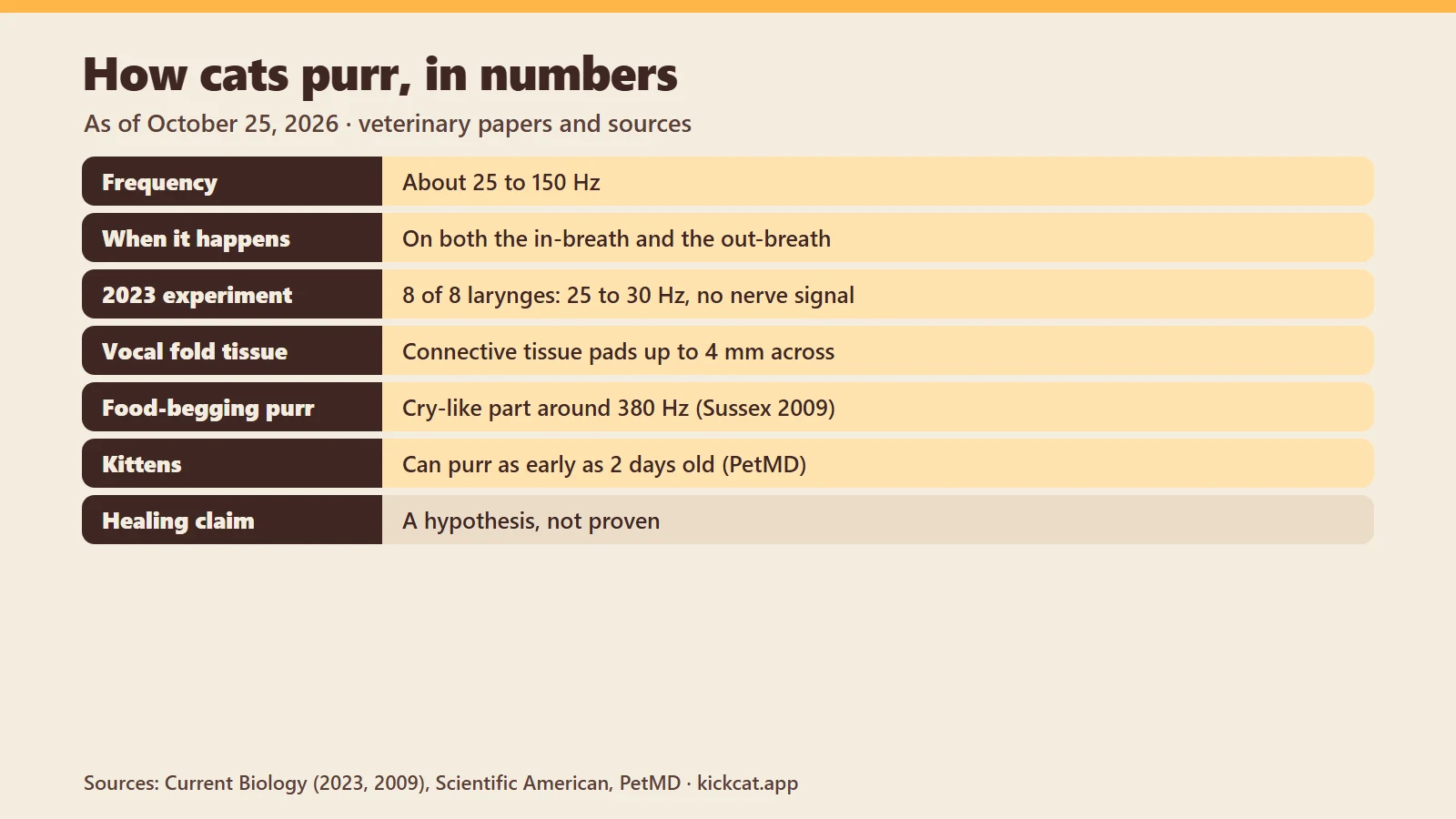
| Frequency | About 25 to 150 Hz (Lyons, Scientific American) |
| When it happens | On both the in-breath and the out-breath |
| Older explanation | Laryngeal and diaphragm muscles twitch on repeated signals |
| 2023 experiment | All 8 larynges vibrated at 25 to 30 Hz with no nerve signal |
| Tissue in the vocal folds | Connective tissue pads up to 4 mm across |
| Food-begging purr | Contains a cry-like component around 380 Hz (Sussex, 2009) |
| Healing claim | A hypothesis, not proven |
The 5 real reasons cats purr
PetMD's guide, reviewed by veterinary behaviorist Wailani Sung, DVM, DACVB, and updated April 1, 2026, sorts purring into contentment, anxiety, greeting, attention-seeking, and illness. Combining that with the research gives five reasons.
1. Comfort and contentment
This is the familiar one. Cats purr when they're relaxed: drowsy, warm, or eating. Lyons notes the purr is most noticeable during social contact with people, such as petting and feeding.
2. Talking with kittens
According to PetMD, kittens can start purring as early as 2 days old, and they purr while nursing. A mother cat may give a short purr as she approaches her kittens, which PetMD counts as a greeting. The brief purr a cat gives as it walks up to you belongs in the same family.
3. Asking for food
In 2009, Karen McComb's team at the University of Sussex published an analysis of purrs from 10 cats in Current Biology. The purrs cats made while asking for food carried a high, cry-like component of about 380 Hz on top of the usual low rumble. National Geographic reported that this pitch is close to that of a crying human baby. Fifty listeners rated these purrs as more urgent and less pleasant than purrs recorded while cats rested or were petted. When the researchers removed the cry component, listeners could no longer tell the difference. Cats with the most one-to-one time with their owners used this purr most often.
4. Calming down when scared or hurt
This is why a purr isn't proof that all is well. Lyons points out that cats purr under stress, such as at a vet visit or while recovering from an injury. PetMD describes it as a possible self-soothing or coping behavior, and also as a possible request for care when a cat is unwell.
5. A healing hypothesis
Lyons wrote that some investigators have linked sound in the 25 to 150 Hz range to better bone density and healing, and speculated that purring could be a low-energy way to stimulate bones and muscles. No direct evidence has been confirmed that a cat's own purr speeds its recovery. For now, treat it as an interesting idea, not a fact.
When a purring cat may be in pain
The sound alone can't tell you whether your cat feels good or bad. Watch the body and the routine around it. PetMD notes that a cat purring while crouched down with its ears pulled slightly to the side may not be feeling well. A vet visit is the safer call if you see any of these:
- Purring while hunched with ears turned slightly out to the side
- Purring alongside a clear change in appetite or activity
- Ongoing purring in a situation where the cat could be hurting, such as after an injury
The key point is not to assume a purring cat can't be in pain. This article is general information and is not a substitute for a veterinarian's diagnosis.
So what is your cat telling you
- Purring on your lap: Usually comfort. Leave it be.
- Purring at the food bowl with a higher, whiny edge: Probably the food-begging purr, a sound research shows people find hard to ignore.
- Purring while hunched and not eating: Possibly coping with pain. Think vet first.
If you're curious about your cat's other habits, read 3 Real Reasons Cats Sleep 12 to 16 Hours a Day, and for the cat-and-dog side of things, 5 Real Reasons Big Dogs Back Down From Tiny Cats. Cats star in games too: KickCat is a free-to-start idle game where the cat keeps kicking the ball even after you close the app.
Information is current as of October 25, 2026. Research figures reflect each paper or source at the time it was published.
FAQ
Do cats only purr when they're happy?
No. Cats purr most often when relaxed, but they also purr when asking for food, when frightened at the vet, and while recovering from injury. Body language and appetite tell you which one it is.
How do cats make the purring sound?
The purr comes from the larynx at roughly 25 to 150 Hz, on both the in-breath and the out-breath. Repeated muscle twitching was the standard explanation, but a 2023 study found that 8 cat larynges vibrated at 25 to 30 Hz with no nerve signal, so the mechanism isn't fully settled.
At what age do kittens start purring?
According to PetMD, kittens can purr as early as 2 days old. They purr while nursing, and mother cats give short purrs as they approach their kittens.
Can a cat's purr heal bones?
That hasn't been confirmed. Some researchers have linked similar frequencies to bone healing, but there is no direct evidence yet that a cat's purr actually speeds up recovery.