Dogs vs Cats and Cognitive Decline: An 18-Year Study
Adults over 50 who owned pets showed slower cognitive decline. Whether pets cause that is still unknown.

Adults over 50 who owned a pet showed a slower decline in memory and verbal fluency than those who did not. That is the finding of a University of Geneva study published in Scientific Reports on May 30, 2025. It is an observational study, though, so it cannot show that pets cause the difference. News coverage of the study often repeats secondary figures, so this article sticks to the numbers in the paper itself.
How the study was done
- Paper: Rostekova A, Lampraki C, Maurer J, Meier C, Wieczorek M, Ihle A. Scientific Reports 2025;15:19066. doi:10.1038/s41598-025-03727-9
- Data: Waves 1, 2 and 4 to 9 of SHARE, the Survey of Health, Ageing and Retirement in Europe, covering 2004 to 2022
- Sample: 16,582 people aged 50 to 99 in 11 countries (average age 63.4, 53.5% women). 1,369 people with dementia, Parkinson's disease and similar conditions were excluded.
- Pet ownership: 39.4% of the sample. There were 1,886 dog owners, 1,778 cat owners, 447 bird owners and 266 fish owners, compared with 10,049 non-owners in the dog comparison.
- Three measures: immediate recall (10 words), delayed recall (about 10 minutes later) and verbal fluency (naming animals within one minute)
Ownership was determined once, at the first survey, from the answer to which of dog, cat, bird, fish, other or none the person currently kept. The number of pets and any later change were not measured.
Results: they differed by species
| Pet | Link to cognitive decline |
|---|---|
| Dog | Slower decline in memory (immediate and delayed recall), no difference in verbal fluency |
| Cat | Slower decline in verbal fluency and delayed recall, no difference in immediate recall |
| Bird | No link to speed of decline, lower scores at the start |
| Fish | No link |
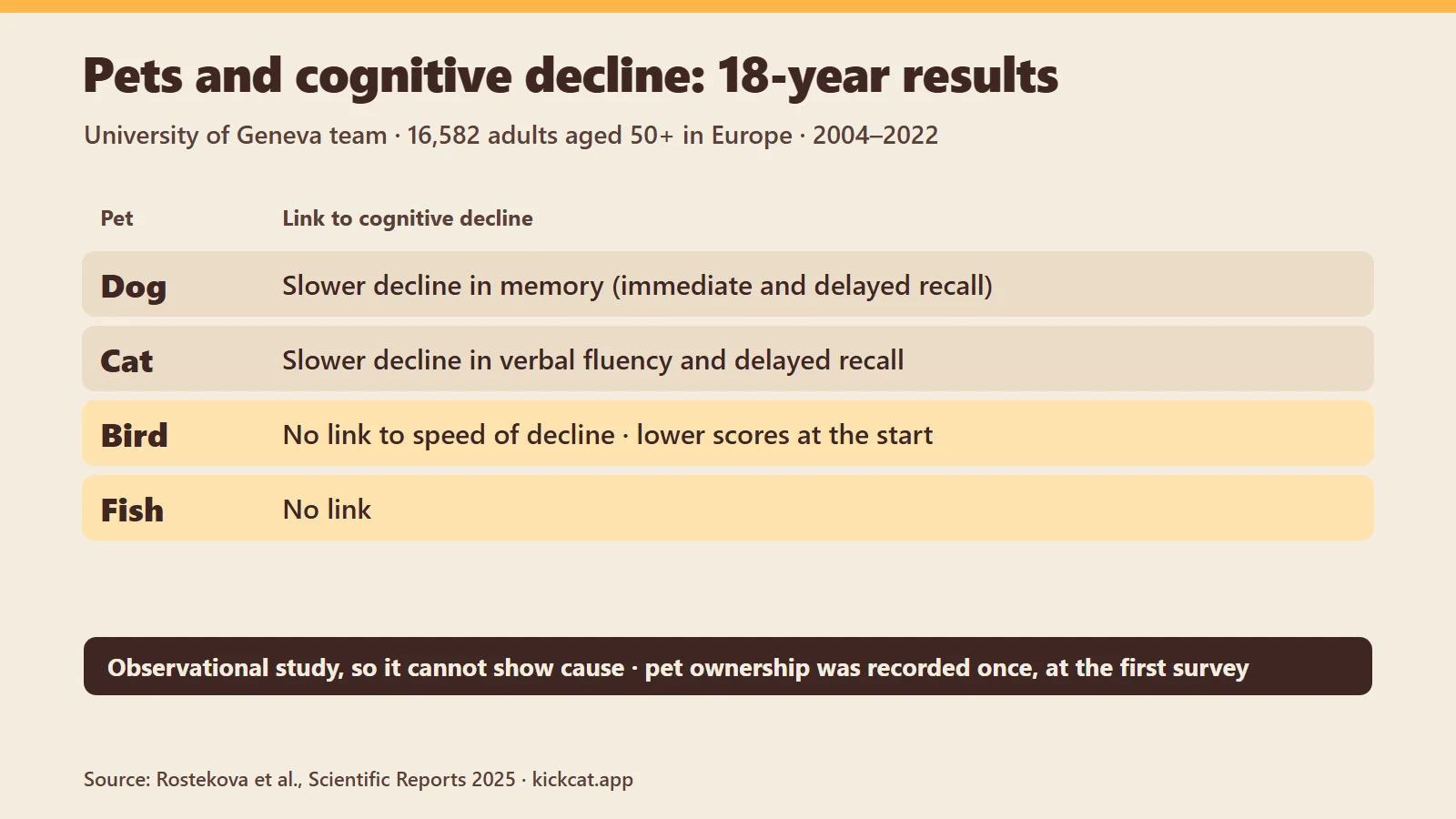
Across all pet owners, decline was slower on all three measures (p<0.001), and the difference did not vary by age group. Splitting by species gives the pattern above. Bird owners started with lower scores, and ownership was not tied to how fast they declined.
What this study does not say
- It does not show a cause. It looks at correlation only. Healthier, more active people may be more likely to keep pets, and the paper notes that owners and non-owners differ on things like depression and anxiety.
- Ownership was measured once. People who adopted or gave up a pet later are not reflected.
- Only European participants were included. The results do not carry over to other regions as they are.
- Memory differences at the start may be chance. The authors state this limitation themselves.
The authors conclude that pet ownership is linked to a slower rate of cognitive decline in later life and that the link depends on species. They add that future work should look at the mechanisms and at policies such as veterinary-cost support and housing for older adults that allows pets. This article is not medical advice, and the study does not show that pets prevent dementia.

How to read the study
- It is not enough of a reason to adopt a pet. An animal is a commitment for its whole life.
- For people who already live with a pet, it is a hypothesis that daily routines like walks and care, and the relationship itself, may help.
- If memory worries you, getting checked by a doctor comes before any pet.
If you are curious about a game built around caring for cats, KickCat is free to start, and its cat keeps kicking balls even with the app closed. Our other cat piece is why cats are beating dogs in Asia.
FAQ
Can owning a pet prevent dementia?
This study does not say so. Pet ownership was linked to a slower rate of cognitive decline, but cause and effect were not established.
Are dogs or cats better for cognition?
Dog ownership was linked to slower decline in memory, and cat ownership to slower decline in verbal fluency and delayed recall. The study did not set out to rank one above the other.
Do birds and fish have no effect?
Birds showed no link to the speed of decline and neither did fish. The bird and fish groups were also much smaller than the dog and cat groups.
Does the study apply outside Europe?
Only participants from 11 European countries were included, so the results cannot simply be carried over to other regions.