Asian Games Esports: 13 Titles, Platforms Ranked by Count
Four of the thirteen are played on a phone. Three years ago the share was higher.

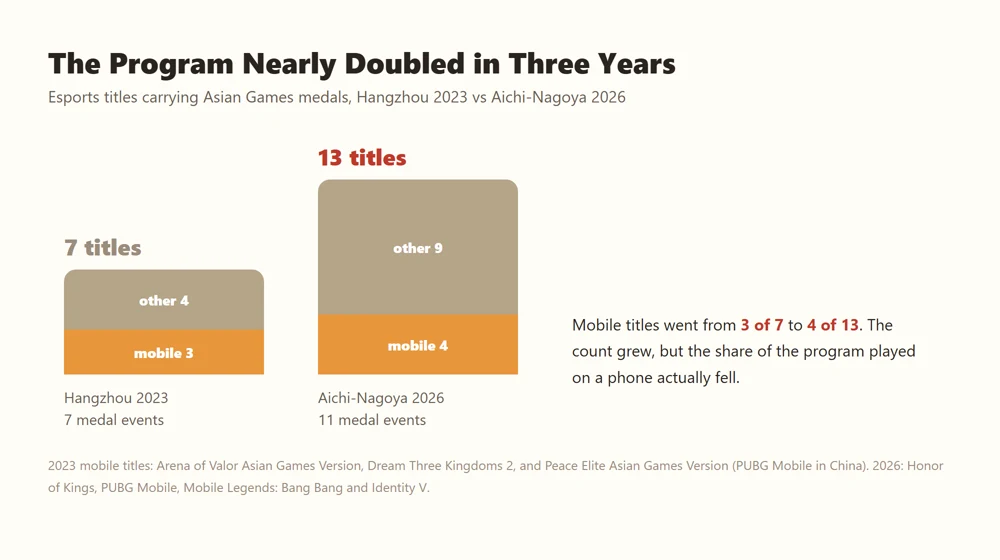
Esports at the Aichi-Nagoya Asian Games starts on September 23. Thirteen titles carry medals, and four of them are played on a phone. That sounds like phones gaining ground. Hangzhou 2023 ran seven titles with three on mobile, so the share just fell from 43% to 31%.
Three countries searched for the same event this week
AGC Lab opened the Google Trends trending-searches page for Korea, Japan and Taiwan on September 20, 2026, and wrote down what was on it.
In Korea, "아시안게임 롤" (Asian Games LoL) sat at 1,000+ searches with a 500% breakout, surrounded by "아시안게임 농구" (basketball), "아시안게임 야구" (baseball) and "아시안게임 일정" (schedule).
Japan had "アジア大会 バスケ" at 20,000+, "アジア大会 サッカー" at 10,000+, and plain "アジア大会" at 10,000+. Taiwan's trending list carried "名古屋亞運" and "亞運開幕", shown by rank only without a volume band.
The Korean list is worth reading for its order rather than its volumes. League of Legends is sitting between basketball and baseball.

Thirteen titles, eleven medals
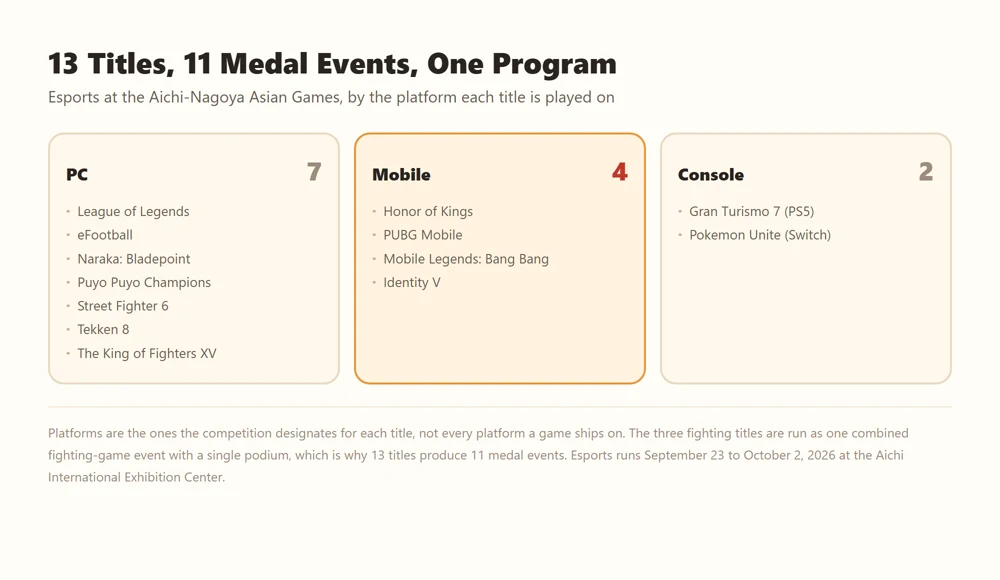
- PC, 7 titles: League of Legends, eFootball, Naraka: Bladepoint, Puyo Puyo Champions, Street Fighter 6, Tekken 8, The King of Fighters XV
- Mobile, 4 titles: Honor of Kings, PUBG Mobile, Mobile Legends: Bang Bang, Identity V
- Console, 2 titles: Gran Turismo 7 (PS5), Pokémon Unite (Switch)
Thirteen titles, eleven medal events. The gap comes from the fighting games: Street Fighter 6, Tekken 8 and The King of Fighters XV are run as one combined fighting-game event with a single podium. The platform labels above are the ones the competition assigns to each title, not the full list of machines each game ships on.
The esports program runs September 23 to October 2 at the Aichi International Exhibition Center. League of Legends is last on the calendar, September 30 to October 2, with eight countries competing. Korea and Taiwan go straight into the main draw without qualifying.
The count went up and the share went down
Hangzhou 2023 ran seven esports titles, three of them on mobile: Arena of Valor Asian Games Version, Dream Three Kingdoms 2, and Peace Elite Asian Games Version, which is PUBG Mobile in China. This time there are four mobile titles out of thirteen. One more than before.
Turn those into percentages and the story inverts. Three of seven is 43%. Four of thirteen is 31%. The program nearly doubled in three years, and PC and console took five of the six new slots. The three fighting games arrived as a block, and Gran Turismo 7 and Pokémon Unite opened a console column that did not exist in 2023 at all.
So why didn't mobile grow faster?
A game becomes a medal event when it can be run the same way, under the same conditions, over and over, with a clean winner at the end. Read the thirteen titles again and one trait shows up in every single one. They are all real-time competitive games where people play against each other at the same moment, and where the result is settled inside a fixed block of play. Honor of Kings and Mobile Legends are 5v5. PUBG Mobile is a battle royale. Identity V is one against four.
Games you play alone, interrupt without penalty and come back to later do not fit those conditions at all. The impression that those dominate phone screens is widely held, and this post has no data to settle it. What the lineup does show is that the overlap between "played on a phone" and "works as a stadium event" is narrow.
The phone game on stage and the phone game on the sofa

The stage version asks for thirty to forty uninterrupted minutes. Take your hands off the screen and you lose that round. The sofa version is the opposite. There are games where opening it once in an elevator and once before bed is the intended way to play, not a compromise.
A lot of the people who looked up the League of Legends schedule this week will probably be watching at that hour. Odds are something else is running on their phone while they do.

KickCat, the one that keeps going while you watch
Who it's for: anyone who wants their phone doing its own thing during a thirty-minute broadcast. First run: about three minutes in, you pick one of three skill cards. What I liked: the cat wears the helmet because he is a coward, which is why he charges with his eyes shut, and every enemy across 300 stages is a dog. What's weak: progress keeps running while the app is closed and gold collects in a vault, but the vault fills up after 12 hours, and anything earned past that point is simply gone. Open it twice a day or lose some. Free-to-play feel: free with ads and in-app purchases, Android only for now while the iOS build is in preparation. (Game data as of 2026-09-20; the numbers for all 24 balls are published in the item index.)

What to do with this week
- If you follow the matches: pick League of Legends. September 30 to October 2, and Korea and Taiwan are in the main draw from the first game.
- If you only care about the phone titles: all four are real-time competitive games, so playing one while watching another match is not realistic. PUBG Mobile is the easiest of the four to follow cold, because a shrinking player count explains itself.
- If you want something running during the broadcast: this is a one-hand week. An idle game like KickCat fits that gap specifically.
The stage structure is laid out on the Churu Road, and last week's four one-handed games covers the same ground from the other side. Install it from Google Play and the vault fills while the opening ceremony is on.
FAQ
When and where is Asian Games esports being held?
Esports at the Aichi-Nagoya Asian Games runs from September 23 to October 2, 2026, at the Aichi International Exhibition Center. League of Legends is the final event, played September 30 to October 2, with eight countries taking part; Korea and Taiwan enter the main draw without qualifying.
How many titles and how many medals are there?
The Aichi-Nagoya Asian Games esports program has 13 medal-bearing titles but only 11 medal events, as of 2026-09-20. Street Fighter 6, Tekken 8 and The King of Fighters XV are combined into a single fighting-game event that awards one set of medals, which is why the two numbers differ.
How many mobile games made the lineup?
Four of the 13 esports titles at the Aichi-Nagoya Asian Games are mobile games, as of 2026-09-20: Honor of Kings, PUBG Mobile, Mobile Legends: Bang Bang and Identity V. Hangzhou 2023 had three mobile titles out of seven, so the count rose by one while mobile's share of the program fell from 43% to 31%.